





Treasury and Other Products > Treasury > Products And Services
Products and Services that suits your need


Forward Contract
It is a contract between the bank and its customers in which the exchange/conversion of currencies would take place at future date at a rate of exchange in advance under the contract.
The essential idea of entering into a forward contract is to fix the exchange rate in advance and thereby avoid the exchange rate risk.
Forward Rates = spot rate +/- premium/discount
Forward contract is used for hedging the foreign exchange risk for future settlement. For example, An importer or exporter having FX contract limit may lock in current exchange rate by entering into forward contract with the bank to avoid adverse rate movement.
Two types of forward contract are available:
- Fixed Date Delivery – Forward contract with settlement on a specific future date.
- Optional Delivery – Forward contract with settlement within specific future period.
Maximum contract tenor is 12 months from the date of contract booking.
Customer may book forward contracts in all the major currency pairs, as USD, EUR, GBP, JPY, AUD, CAD, CHF and INR etc.

FX-Retail
FX-Retail and its Uses
The Reserve Bank of India in its Statement on Developmental and Regulatory Policies dated June 6, 2019 had announced the launch of an electronic trading platform for trading in foreign exchange by retail customers of banks. Accordingly, the Reserve Bank of India issued a notification on June 20, 2019 informing about the launch of a foreign exchange trading platform called FX-Retail, developed and managed by the Clearing Corporation of India Limited (CCIL) for retail participants. The customer registration process on the above platform was started from July 1, 2019 and trading on the above platform was started from August 5, 2019.


Reserve Bank of India has highlighted that this platform provides transparency and fair pricing to retail users (Individuals, Corporates and Micro, Small and Medium Enterprises) in foreign exchange.
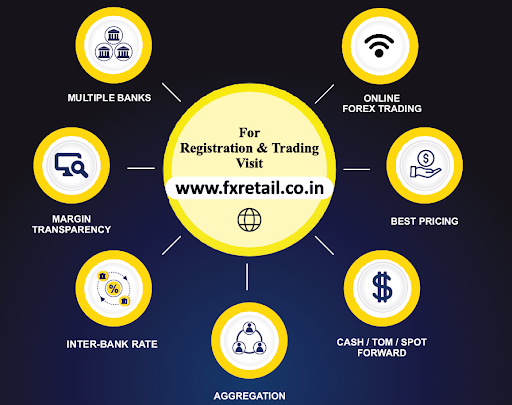
Clearing Corporation of India Limited has developed a web based, FX- Retail Trading platform for retail participants which includes individuals, corporates, micro, small and medium enterprises etc., to trade in foreign exchange. This web-based platform can be used for trading in foreign exchange in the form of US Dollar/INR currency pair. Bank's customers who need to buy or sell US Dollars in exchange for Rupees can access the FX-Retail platform through the website https://www.fxretail.co.in.
Union Bank of India's performance in FX-Retail
Many MSME and corporate customers of Union Bank of India are using FX-Retail facility, and bank aims to add more customers in the future. Union Bank of India has achieved tremendous success in the foreign exchange (FX-Retail) business. The bank has understood the needs of the customers and provided them with excellent services, which has increased the trust of the customers. The bank aims to provide this facility to more customers in the coming time so that they can fulfill their business needs through this facility. Union Bank of India is looking forward to further improving its services by keeping in mind the future needs of the customers. The bank believes that it can expand its services only by building strong relationships with customers and understanding their changing needs. As part of this strategy, Union Bank of India is committed to add more customers to FX-Retail service.

Customer Registration Process
The customer has to visit the FX-Retail link https://www.fxretail.co.in to register himself. The customer has to register himself using the “register here” button on the homepage where the registration page will be displayed, wherein the customer has to enter the following details:
- Profile Details
- Bank relationship details
- Default user information for creating user credentials
Once the customer has entered all the required details, customer can preview all the fields by clicking on the preview and submit option. To get approved, the customer has to submit the “FX-Retail Limit Request Form” to the respective branch after entering the bank details in the relationship menu. Union Bank of India determines the order amount ceiling limit and the bank's exchange mark-up margin on the platform based on the customer's request. Once the same gets approved by bank, the customer receives user credentials on his registered email ID. A link to the transaction platform is also provided through the email.
Features of FX-Retail
- Internet-based: Customers can access the platform via the internet network.
- Instruments: Customers can trade in US Dollar/INR pair on the platform.
- Order size: Maximum single transactions up to 5 million US Dollars are allowed.
- Execution : Orders will be matched based on price and time priority.
- Limit Order: The customer can place, modify and cancel orders on the trading platform.
- Session Timings: Trading session timings for Union Bank of India customers will be as per the existing regular business timings.
- SMS Facility: Available for customer registration, login, One Time Password (OTP), trade details etc.
Transaction Limits and Charges
- One-time registration charges have been fixed by CCIL as free of cost for individuals and proprietorship concerns and Rs. 1000.00 for others like Partnership Firms, Companies & Corporates etc.
- There is no limit on the number of transactions per customer in a day. The total amount of customer transactions will be subject to the order amount ceiling limit set by the bank.
- Single transaction up to a Maximum of 5.00 million US Dollar will be permitted.
- CCIL will not levy any transaction charges for transactions less than USD 50,000.00 per day.
- CCIL will levy a nominal charge of 0.0004% for transactions above USD 50,000.00.
- Exchange mark-up margin will be applicable as per the approval given by bank to the customer.
Union Bank of India is not charging any extra fee from its customers for this facility but transaction charges levied by CCIL will be payable by the Customer and will be settled from the Customer's account.
Transaction Processing -- FX-Retail (Union Bank of India)
Before buying or selling foreign currency on FX-Retail, the bank needs to set order amount ceiling limits and exchange mark-up value for the customer on the platform as per customer registration process given earlier. After submitting completely filled transaction forms e.g., request letter, A2 Form and declaration in accordance with Foreign Exchange Management Act (FEMA) to the concerned branch, the customer can place orders on the FX-Retail platform within the validity period and up to the limit prescribed by the Bank.
On successful completion of the FX-Retail order, an order confirmation SMS is sent to the customer on their registered mobile number. The customer needs to immediately contact the concerned branch with this order confirmation along with any other documents as required by bank/branch for execution of the transaction.
Benefits of FX-Retail Platform Facility to Foreign Exchange Market Participants
- Customers can buy/sell US Dollars at the best exchange rate.
- Customers can deal directly on the platform and get access to current market rates, thus moving from telephone-based trading to electronic trading.
- The platform provides transparency and better value to the customers.
- The customer will get a dealing platform that also offers automated price discovery facility apart from other qualitative benefits.
- Security is ensured through 2 step authentication (Password & OTP).
- Access to inter-bank exchange rates is possible.
- Facility to add more than one relationship banks is available.
- Facility to set transaction priorities is available.
- Provides a better comparative view on prices and mark-ups.
- Facility to send information through SMS is available for each trade.
FX-Retail is an initiative by RBI to promote fair, transparent and competitive rates for the customers, where the customers have the option available to them to get the best value in the foreign exchange market.
Union Bank of India is one of the first banks to offer its customers the FX-Retail platform powered by CCIL and through this the Bank has made it extremely easy for all its customers to carry out foreign exchange transactions in greater volumes.
Customers can register by visiting FX-Retail home page- https://www.fxretail.co.in/#/login and clicking on “Register Here”.
Any customer including Individuals, Corporates, Micro, Small and Medium Enterprises (MSMEs) etc. can register for the FX-Retail platform. Currently, there are 29 customer categories available in the drop down of the registration form. Please see the list of customer categories available on the FX-Retail page of the CCIL website www.ccilindia.com
Yes, customer needs to upload the scanned copy of PAN card in any of the following formats: jpg, png and pdf , whose size should not exceed 200 kb.
Registration facility at FX-Retail is available free of cost for Individuals, NRIs , Hindu Undivided Families (HUF), Sole Proprietorship and for Non-Individuals with a one-time fee of Rs. 1000/- (inclusive of applicable GST). However, this is a one-time registration fee which is charged only at the time of first time registration and is not charged for Add Bank registration.
Yes, it is necessary to verify the email ID and mobile number through OTP during the registration process.
After approval at the bank, customer will receive the user credentials on the registered email ID.
Customer may contact the respective branch to know the status of registration or may contact FX Retail Support at the following contact details:
FX-Retail Support:-
Union Bank of India:
Tel: 022-41721223, 41721224
(Monday to Friday, From 10:00 am to 5:00 pm)
Email: fxretail.treasury@unionbankofindia.bank
Clearing Corporation of India Limited:
Tel: 1800 266 2109 (Toll Free) / +91 22 61546313
(Monday to Friday, From 8:00 am to 7:30 pm)
Yes. The customer can set the default order price in the customer profile screen under "my preferences" and enter the order price in US Dollars.
Yes. A corporate who has been granted User Management rights in the main menu/sub menu can add additional users and assign dealing rights to such users.
Yes. Customers can select or enable pre - order confirmation (popup alert) in the customer profile screen under ' my preferences ' by selecting "Yes" for pre-order confirmation.
Yes. The customer has the facility to cancel or modify an order already placed by him as long as the order is pending or not executed.
The minimum and maximum single order size that can be placed / traded on the FX-Retail platform is US$ 0.01 (i.e 1 cent) and US$ 5,000,000.00 respectively.
Yes. The details of top 5 bids and top 5 offers are available to the user in the Market Depth tab for Retail Spot. The market depth of bids and offers of the inter-bank market is also available on the platform to the user for reference.
Yes . The net price shall be the final trade price after adjusting for the mark up charged to the customer.
Trading limits are set by the respective branches of the Bank for their customers, so that the customer can trade in US Dollar/INR currency pair on the platform to book foreign exchange contracts.

Forward Rate Agreements
An FRA is an agreement between the Bank and a Customer to pay or receive the difference (called settlement money) between an agreed fixed rate (FRA rate) and the interest rate prevailing on stipulated future date (the fixing date) based on a notional amount for an agreed period (the contract period).
In short, this is a contract whereby interest rate is fixed now for a future period.
The basic purpose of the FRA is to hedge the interest rate risk.
For example, if a borrower is going to borrow FC loan for 6 months at ARR rate after 3 months, he can buy an FRA whereby he can fix interest rate for the loan
FRAs can be used by customer who has a desire or need to alter their interest rate or cash flow profile to suit their particular needs. FRAs are used by customer looking to protect themselves from, or take advantage of, future interest rate movements.
A FRA can be arranged for one to six month terms, commencing up to 18 months from deal date.
By entering into a FRA Customer has expressed his view on interest rates. If interest rate movements be different to his expectations the FRA may have the opposite effect to what customer are trying to achieve with the transaction.
Customer can however, reverse or terminate the FRA.

Interest Rate Swaps
It is a contractual agreement to exchange a series of cash flows, in which one leg of cash flow is based on a fixed interest rate and the other leg is based on a floating rate. The cash flows are calculated and exchanged based on notional principal. There is no exchange of principal. IRS can also be floating to floating wherein either legs are floating.
The basic purpose of IRS is to hedge the interest rate risk of constituents and enable them to structure the asset/liability profile best suited to their respective cash flows.
When agreeing on an interest-rate swap, the bank and the customer trade variable and fixed rates. Under the interest rate swap the customer receives from the bank the variable rate of interest it owns under its loan(s) excluding any variable mark-ups, and subsequently pays a fixed rate as agreed under the interest rate swap to the bank. This set-up protects customer from increases in interest rates. Customer still has to pay any variable mark-ups and that these are not covered by interest-rate swaps.

Currency Futures
Currency futures are standardized, exchange-traded contracts to buy or sell a currency at a specific price sometime in the future. As an essential tool to manage the risks associated with changing currency valuations, Currency futures allow market participants to lock in a currency rate for a specific time period.
At the same time, Currency futures offer a means of potential profits for those who wish to take a view on currency fluctuations, and in doing so accept the risk that businesses and financial institutions wish to offset with electronic trading and efficient risk management systems. Exchange traded currency future allow Corporate and Households alike to hedge their currency risk, to protect or increase investment returns and to trade in USDINR, EURINR, GBPINR and JPYINR without the need to have an underlying exposure.

Currency Swaps
It is an agreement between two parties to exchange obligations in different currencies at the beginning, during the tenure and at the end of the transaction. At the start, initial principal is exchanged, though not obligatory. Periodic interest payments (either fixed or floating) are exchanged throughout the life of the contract. The principal is exchanged invariably on termination at the exchange rate decided at the start of the transaction.
By means of currency swap, the counterparties can hedge their exchange rate and interest rate risk and also reduce the cost of funding.
In a currency swap operation, also known as a cross currency swap, the parties involved agree under contract to exchange the following: the principal amount of a loan in one currency and the interest applicable on it during a specified period of time for a corresponding amount and applicable interest in a second currency.
In a typical currency swap transaction, the first party borrows a specified amount of foreign currency from the counterparty at the foreign exchange rate in effect. At the same time, it lends a corresponding amount to the counterparty in the currency that it holds. For the duration of the contract, each participant pays interest to the other in the currency of the principal that it received. Upon the expiration of the contract at a later date, both parties make repayment of the principal to one another.
Currency swaps are often used to exchange fixed-interest rate payments on debt for floating-rate payments; that is, debt in which payments can vary with the upward or downward movement of interest rates. However, they can also be used for fixed rate-for-fixed rate and floating rate-for-floating rate transactions.
The benefits for a participant in such an operation may include obtaining financing at a lower interest rate than available in the local market, and locking in a predetermined exchange rate for servicing a debt obligation in a foreign currency.

Options
It is a contract between the bank and its customers in which the customer has the right but not obligation to buy/sell a specified amount of underlying asset at fixed price within a specific period of time, but has no obligation to do so.
Premium – it is the price paid by the buyer to the seller to acquire the right to buy / sell.
Strike Price – The specified / predetermined price of the underlying asset, at which the option can be bought or sold.
This is in contrast of the forward contract in which both parties have a binding contract.
The right to sell a security is called a 'Put Option', while the right to buy is called the 'Call Option'. Option Contract can be used to :
Making profit from changes in price of the underlying assets without investing in the same.
Option contract can also be used to safeguard from fluctuations in the price of underlying assets buying or selling the underlying assets at a pre-determined price for a specified period of time.
MTM gains and losses on options are adjusted against the available liquid margins. The net option value is computed using the closing price of the option and are applied the next day.
Exercise Date – it is the date on which the option is actually exercised.
European Options - European options are options that can be exercised only on the expiration date. All index options traded at NSE are European Options.
In- the- money options (ITM) - An in-the-money option is an option that results in gain if it is exercised immediately.
At-the-money-option (ATM) - An at-the money option is an option that that results in no profit no loss situation if it is exercised immediately.
Out-of-the-money-option (OTM) - An out-of- the-money Option is an option that results in loss if it were exercised immediately.

Primary Dealer
Union Bank of India also works as a bank cum Primary Dealer. The Bank provides facility to its valued customers (companies, corporate bodies, firms, institutions, provident funds trusts, regional rural banks, urban cooperative banks and non-banking financial companies) access to invest in Government Securities as allowed by Reserve Bank of India for non-competitive bidding.

Debt Syndication Activity
Treasury Branch advises to the Corporates/NBFCs on their Bond issuance and also undertaking Debt Syndication activity by participating in the Bonds/Debentures of Public Sector Undertakings / Financial Institutions / NBFCs / Corporates. In order to leverage the existing relationship with the clients Treasury may facilitate their CPs/Bond issuance through existing outreach in the market.

RBI Retail Direct Scheme
Retail Direct Scheme is a one-stop solution to facilitiate investment in Government Securities by individual investors. Under this scheme individual retail investor can open a Gilt Securities Account – “Retail Direct Gilt (RDG)” account with RBI. Using this account, retail investor can buy and sell government securities through the online portal: https://rbiretaildirect.org.in
RBI Retail Direct Support: -
website: https://rbiretaildirect.org.in
Email: support@rbiretaildirect.org.in
1800 267 7955 / 022 69385050 / 022 41075000
(10am – 6pm / Mon – Sat)